


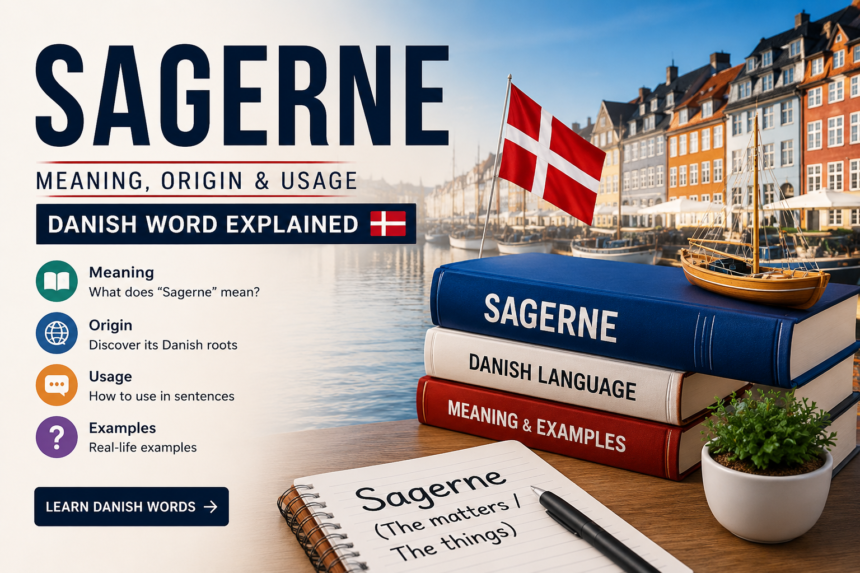
Language is full of fascinating words that carry meanings beyond their simple appearance. One such word is Sagerne, a Danish term that often creates curiosity among language learners, translators, and people exploring Scandinavian culture. At first glance, it may seem like just another foreign word, but understanding its meaning opens the door to a deeper appreciation of Danish grammar, communication, and context.
- What Does Sagerne Mean?
- The Grammar Behind Sagerne
- The Historical Background of the Word
- How Sagerne Is Used in Everyday Danish
- Sagerne in Legal Contexts
- Sagerne in Government and Administration
- Sagerne in Business Communication
- Why Context Changes the Meaning of Sagerne
- Why Sagerne Matters for Language Learners
- Sagerne and Translation Challenges
The word Sagerne appears in everyday conversations, official documents, legal discussions, news reports, and business communication throughout Denmark. Because it can refer to different types of matters, cases, or issues depending on the situation, it is an excellent example of how context shapes language.
For anyone interested in Danish vocabulary, translation, or linguistic studies, learning about Sagerne is both practical and rewarding. This guide explores its meaning, grammar, usage, examples, and importance in modern communication.
What Does Sagerne Mean?
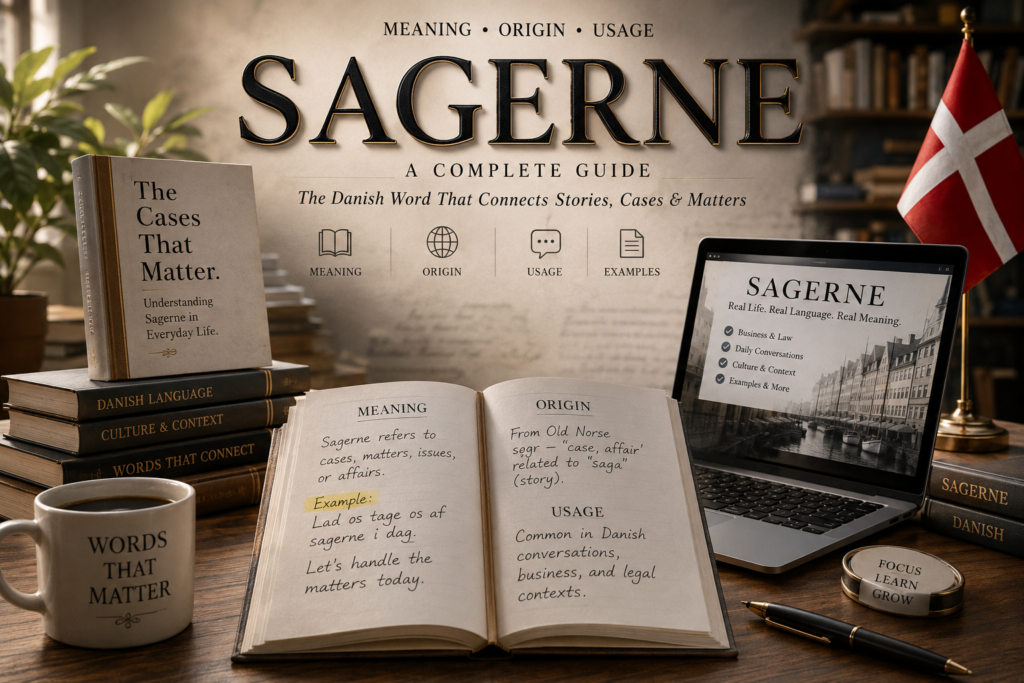
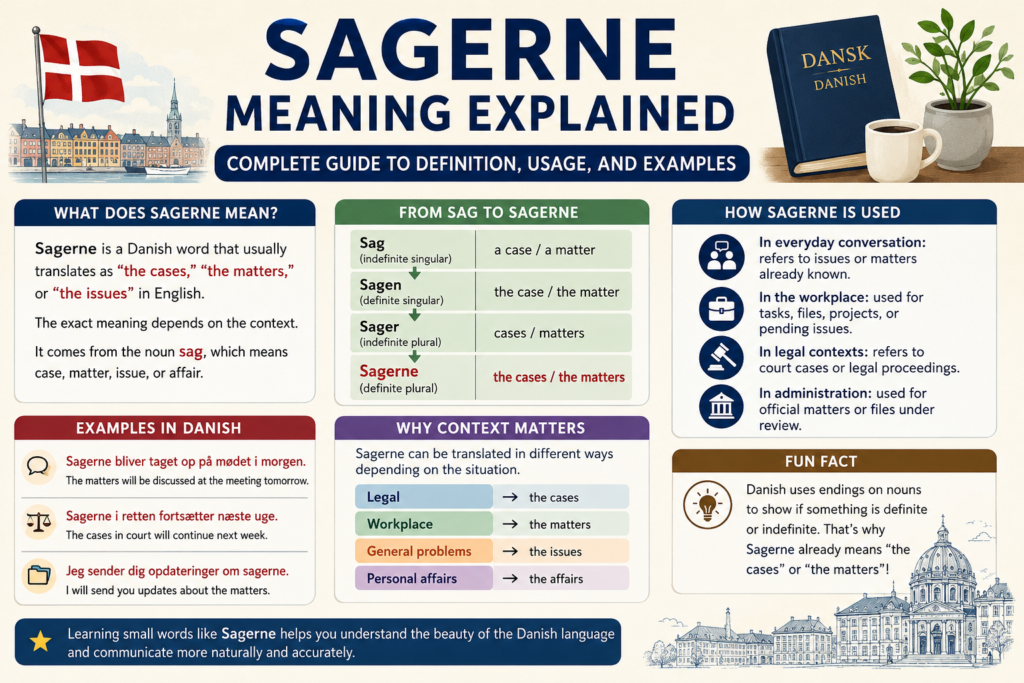
The word Sagerne is a Danish noun that generally translates into English as “the cases,” “the matters,” or “the issues.” The exact translation depends on the context in which it appears.
In Danish, the root word is sag, which means a case, matter, issue, affair, or topic. When speakers want to refer to multiple cases or matters, they use the plural form sager. When those matters are specific and already known to the listener or reader, the definite plural form sagerne is used.
For example, if someone says they are discussing sagerne, they are referring to particular matters that have already been identified. In English, this is similar to saying “the matters we discussed earlier” or “the cases currently under review.”
The beauty of the word lies in its flexibility. It can refer to legal disputes, workplace projects, administrative files, personal issues, or even topics of discussion. This broad application makes it one of the most useful words in Danish communication.
 You might also like: Readmymanga com
The Grammar Behind Sagerne
Understanding the grammar behind Sagerne helps explain why the word appears in this specific form.
Unlike English, Danish often attaches definite articles directly to nouns. Instead of placing a separate word like “the” before a noun, Danish commonly adds an ending to the noun itself.
This grammatical structure creates different forms of the same word depending on whether it is singular, plural, definite, or indefinite.
From Sag to Sagerne
The development of the word follows a simple pattern.
Sag means a case, matter, or issue.
Sagen means the case or the matter.
Sager means cases or matters.
Sagerne means the cases or the matters.
This system is common throughout the Danish language. Once learners understand how Sagerne is formed, they can recognize similar patterns in hundreds of other Danish nouns.
Learning these forms also improves reading comprehension because many Danish texts rely heavily on these noun endings rather than separate articles.
The Historical Background of the Word
Like many Scandinavian words, Sagerne originates from older Nordic language traditions. The root word sag has existed for centuries and has been used in various forms throughout Danish history.
Historically, the word often referred to legal disputes, matters brought before authorities, or significant issues affecting communities. Over time, its meaning expanded beyond legal settings and became part of everyday speech.
Today, modern Danish speakers use Sagerne in a variety of contexts without necessarily thinking about its historical origins. However, understanding this background provides insight into why the word remains closely associated with important matters requiring attention or discussion.
The evolution of the word demonstrates how language adapts to society while maintaining connections to its roots.
You might also like: 8.3 Independent Practice Page 221 Answer Key
How Sagerne Is Used in Everyday Danish
One reason Sagerne is such a valuable word is its widespread use in daily life.
In ordinary conversations, people may use it when talking about family matters, workplace responsibilities, community concerns, or ongoing situations. Because the word is neutral, it fits comfortably into both formal and informal communication.
For example, a manager might discuss pending office matters and refer to them collectively as Sagerne. A journalist could use the term when reporting on political issues. Friends might use it while discussing matters that need to be resolved.
This flexibility allows the word to remain relevant in countless situations. Rather than being limited to one field, Sagerne functions as a practical term for discussing specific matters that require attention.
Its versatility is one reason it appears so frequently in Danish media, official communication, and everyday speech.
Sagerne in Legal Contexts
One of the most common places where Sagerne appears is within legal communication.
In legal settings, the word usually refers to specific court cases, disputes, legal proceedings, or investigations. Here, the translation “the cases” is often the most accurate.
Legal professionals use the term when discussing ongoing proceedings, reviewing case files, or communicating about judicial matters. Because precision is important in law, understanding the context helps ensure accurate translation.
For translators working with Danish legal documents, recognizing when Sagerne refers to actual court cases is essential. Translating it simply as “issues” may weaken the intended legal meaning.
As a result, legal context often provides the clearest and most direct interpretation of the word.
Sagerne in Government and Administration
Government offices and administrative organizations also use the word regularly.
In these environments, Sagerne often refers to files, applications, requests, reports, or administrative matters that require processing. Employees may discuss which cases are completed, pending, or awaiting approval.
Because public institutions handle large amounts of information, the term serves as an efficient way to refer collectively to official matters.
Administrative usage demonstrates how language supports organization and communication within institutions. Rather than listing individual items repeatedly, officials can simply refer to Sagerne when discussing a group of related matters.
This practical usage explains why the word frequently appears in government documents and public communications.
Sagerne in Business Communication
The business world also relies heavily on the term.
Companies use Sagerne when discussing projects, client requests, internal issues, and operational matters. Managers may ask employees for updates on important cases, while departments may coordinate efforts to resolve ongoing concerns.
In professional settings, the word helps keep communication concise and organized. Rather than repeatedly naming each matter, teams can refer collectively to Sagerne.
Business communication often values efficiency, and this term contributes to that goal by providing a clear and adaptable way to discuss multiple matters simultaneously.
Because modern workplaces require constant coordination, the word continues to play an important role in Danish corporate culture.
You might also like: CNLawBlog
Why Context Changes the Meaning of Sagerne
One of the most interesting aspects of Sagerne is that its English translation changes depending on context.
- In legal discussions, it usually means cases.
- In business settings, it may matter.
- In conversations about problems, it may mean issues.
- In some situations, it can even be translated as affairs or topics.
This flexibility demonstrates an important principle in language learning: words rarely exist in isolation. Their meaning is shaped by surrounding words, subject matter, and communication goals.
Understanding context allows translators and learners to choose the most natural English equivalent. This skill is crucial for producing accurate translations and interpreting texts correctly.
Without context, even simple words can become misleading.
Why Sagerne Matters for Language Learners
For Danish learners, Sagerne provides a valuable lesson in both grammar and vocabulary.
Learning the progression from sag to sagen, sager, and sagerne helps students understand how Danish nouns change form. This knowledge can then be applied to many other words throughout the language.
The word also highlights the importance of context. Students quickly discover that direct word-for-word translation is not always sufficient. Instead, understanding the overall meaning of a sentence leads to a more accurate interpretation.
Because Sagerne appears frequently in news articles, official documents, and conversations, mastering it improves overall language comprehension.
Many language learners find that understanding common words like Sagerne significantly boosts their confidence when reading Danish materials.
Sagerne and Translation Challenges
Translation is rarely as simple as replacing one word with another.
Because Sagerne can mean cases, matters, issues, affairs, or topics, translators must analyze the surrounding content carefully. Choosing the wrong translation can alter the meaning of an entire sentence.
Professional translators often consider factors such as audience, purpose, tone, and subject matter before deciding how to translate the word.
This challenge makes Sagerne an excellent example for translation students. It illustrates why language expertise involves more than vocabulary memorization.
Successful translation requires understanding meaning, context, and cultural usage.
Conclusion
Sagerne may appear to be a simple Danish word, but it represents much more than a direct translation. As the definite plural form of sag, it commonly means “the cases,” “the matters,” or “the issues,” depending on context. Its flexibility allows it to function effectively in legal discussions, business communication, government administration, journalism, and everyday conversation.
For language learners, Sagerne offers valuable insights into Danish grammar and word formation. For translators, it serves as a reminder that context always matters. Anyone interested in Scandinavian languages, understanding Sagerne provides a deeper appreciation of how meaning is shaped by usage and situation.
The next time you encounter Sagerne in a Danish text, you will not simply see a foreign word. You will recognize a versatile term that connects grammar, communication, and meaning practically and fascinatingly.
FAQs
What does Sagerne mean in English?
Sagerne usually means “the cases,” “the matters,” or “the issues,” depending on the context in which it is used.
Is Sagerne a Danish word?
Yes, Sagerne is a Danish word and is the definite plural form of the noun sag.
What is the singular form of Sagerne?
The singular form is sag, which generally means a case, matter, issue, or affair.
Can Sagerne be used in legal language?
Yes, it is commonly used in legal settings to refer to specific court cases or legal proceedings.
Why is Sagerne important for language learners?
It helps learners understand Danish noun forms, definite endings, and the role context plays in translation and communication.