


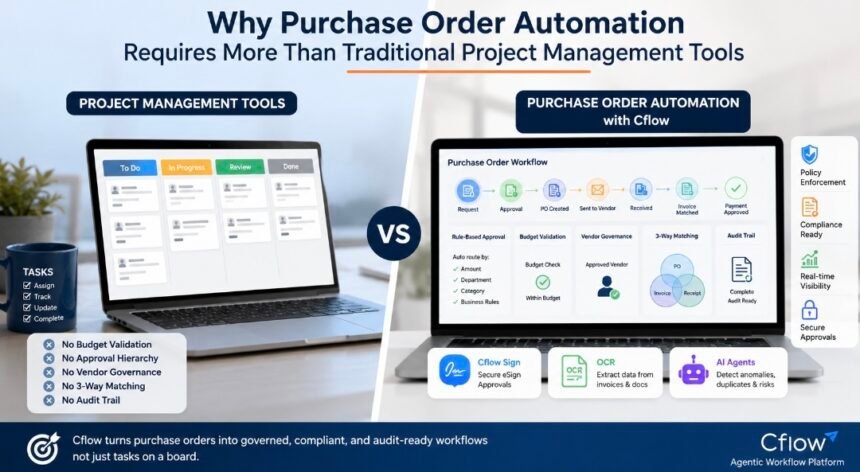
Project management tools and purchase order workflows may appear similar on the surface because both involve multiple tasks and stakeholders. The difference is that purchase orders represent financial commitments, making governance, approvals, and compliance just as important as progress tracking. That’s where purpose-built purchase order automation becomes essential.
Purchase order automation exists specifically because manual and semi-manual PO processing is expensive. One widely cited study estimates that processing a single purchase order manually can cost more than $500, largely because of the time, handoffs, and errors involved in moving a request from requisition to payment. A project management board can visualize that movement, but visualizing a process and controlling it are two very different things. That difference is exactly why purchase order automation has become essential.
Where Project Management Tools Fall Short for Purchase Orders
Project management tools are designed to answer a simple question well: Is this task complete, and who is responsible for the next step? That works perfectly for sprint planning, marketing campaigns, or content calendars. Procurement operates differently.
A purchase order needs more than status tracking. It needs governance. The system must determine whether a request stays within budget, whether additional approvals are required beyond a certain spending limit, whether the vendor is approved, and whether similar items have already been ordered recently. Traditional project management platforms do not natively support budget validation, financial approval hierarchies, or vendor governance. Attempting to recreate these controls using custom fields and manual conventions often results in a process that is difficult to maintain.
Another limitation appears after approval. In a project management tool, an approved task usually moves to a completed column. Procurement continues well beyond that point. Once a purchase order is approved, it must be sent to the vendor, matched against invoices and goods receipts, and eventually approved for payment. These downstream financial controls fall outside the scope of most project management platforms.
What Purchase Order Automation Actually Requires
A complete purchase order workflow includes several capabilities that task management platforms are not designed to provide.
Rule-based approval routing. Approval paths should automatically change based on purchase amount, department, category, or business rules without requiring manual reassignment.
Budget validation before approval. Spending should be verified against available budgets before commitments are made, preventing overspending instead of detecting it later.
Vendor governance. Requests involving unapproved or restricted vendors should be identified immediately so procurement teams can address the issue before orders are issued.
Three-way matching. Purchase orders, supplier invoices, and goods receipts should be reconciled before payments are released, providing an essential financial control.
Complete audit trails. Every approval, rejection, escalation, and policy decision should be recorded automatically to simplify compliance and internal audits.
Where Cflow Fits as an Agentic Workflow Platform
This is the gap Cflow is designed to address. As an Agentic Workflow Platform, Cflow manages purchase orders as governed financial workflows rather than simple task cards. Requests are automatically routed based on purchase value, department, vendor, and approval policies while maintaining complete visibility throughout the process.
Several built-in capabilities simplify procurement operations. Cflow Sign supports secure electronic approvals without requiring separate signing applications. OCR extracts information directly from supplier invoices and supporting documents, reducing manual data entry and improving accuracy. Kanban boards provide procurement teams with clear visibility into every purchase order while preserving structured approval workflows and financial controls behind the scenes.
As AI Workflow Software with Custom Agents, Cflow also enables organizations to configure intelligent agents that review purchase requests as they enter the workflow. These agents can identify unusual pricing, duplicate purchase requests, missing documentation, or policy exceptions before approvals move forward, helping procurement teams detect potential issues much earlier in the process.
Conclusion
Project management software can certainly show where a purchase order is within a workflow. However, it cannot provide the financial controls, policy enforcement, vendor governance, and audit readiness that procurement requires. Purchase order automation addresses a fundamentally different business challenge by combining intelligent routing, approval governance, document validation, and financial controls into a single workflow. The result is a procurement process that not only tracks work but also helps ensure every purchase is approved correctly, compliant with policy, and ready for audit.