


Preparing for the RN Fundamentals 2016 70 Questions exam can feel overwhelming, especially for nursing students who are just beginning their journey into professional healthcare. Nursing fundamentals serve as the foundation of every skill, responsibility, and clinical decision that registered nurses make throughout their careers. Because of this, many nursing programs and ATI-based assessments use a 70-question format to evaluate whether students possess the knowledge and clinical judgment necessary to provide safe and effective patient care.
- What Is the RN Fundamentals 2016 70 Questions Exam?
- Understanding the Structure of RN Fundamentals Questions
- Major Content Areas Covered in the RN Fundamentals 2016 70 Questions Assessment
- Safety and Infection Control
- Why Clinical Reasoning Matters More Than Memorization
- The Nursing Process: The Foundation of Patient Care
- Medication Administration and Safety
- Vital Signs and Physical Assessment
- Delegation and Scope of Practice
- Therapeutic Communication
- Prioritization and Clinical Judgment
- Fluid and Electrolyte Balance
- Basic Care and Comfort
- Health Promotion and Disease Prevention
- Ethical and Legal Principles in Nursing
- Why Critical Thinking Is Essential for Success
- Sample RN Fundamentals Questions with Rationales
- Question 1: Infection Control
- Question 2: Prioritization
- Question 3: Delegation
- Question 4: Therapeutic Communication
- High-Yield Topics Students Should Master
- Common Mistakes Students Make
- Test-Taking Strategies for Success
- Two-Week Study Plan
- FAQs
Unlike traditional examinations that rely heavily on memorization, the RN Fundamentals exam challenges students to think critically and apply concepts to real-world patient scenarios. Questions are designed to test how students prioritize care, recognize emergencies, communicate therapeutically, and implement evidence-based interventions. Success on the exam requires more than remembering definitions or facts; it requires understanding the reasoning behind nursing actions and applying those principles correctly.
Whether you are preparing for an ATI assessment, a course final, or building a strong foundation for NCLEX-RN preparation, mastering the concepts covered in the RN Fundamentals 2016 70 Questions assessment can significantly improve both your confidence and your performance. By understanding the structure of the exam and focusing on high-yield topics, students can develop the clinical reasoning skills necessary to succeed not only on exams but also in future nursing practice.
What Is the RN Fundamentals 2016 70 Questions Exam?
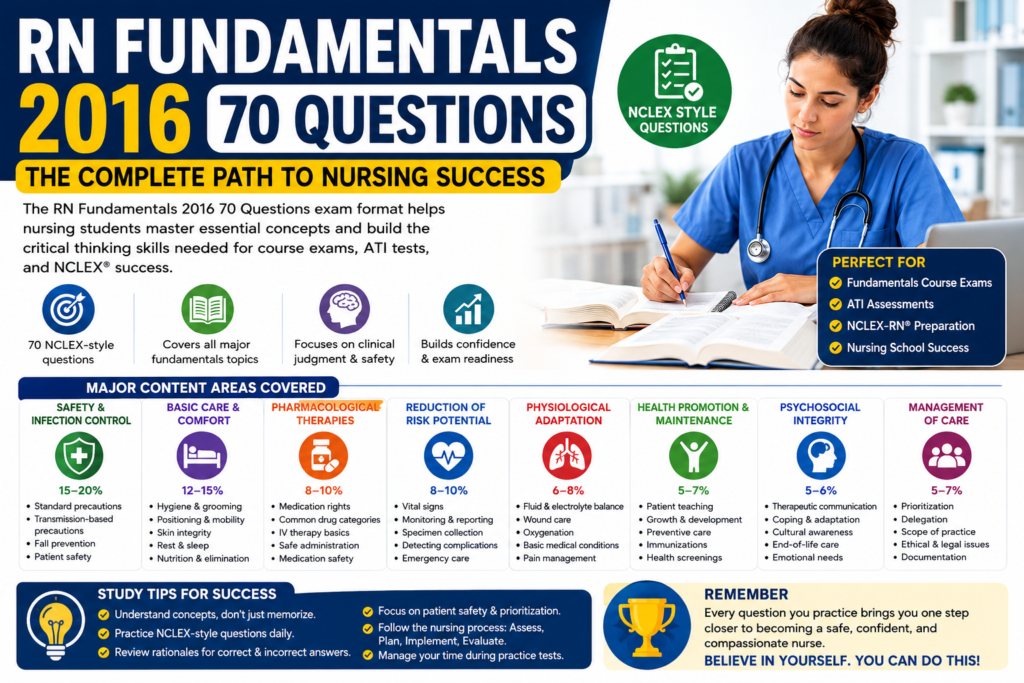
The RN Fundamentals 2016 70 Questions assessment refers to a format commonly used in nursing education and ATI preparation resources to evaluate basic nursing knowledge. Although the examination consists of seventy questions, each question is designed to test multiple concepts simultaneously. Students are expected to demonstrate an understanding of patient safety, infection prevention, medication administration, communication techniques, and nursing priorities while applying their knowledge to realistic clinical situations.
Fundamentals of nursing represent the backbone of professional nursing practice. Every advanced specialty area, including medical-surgical nursing, pediatric nursing, maternal-child nursing, psychiatric nursing, and critical care, depends upon the concepts learned during this stage. Without a strong understanding of these principles, nurses cannot safely deliver patient care.
The examination typically includes content related to safety and infection control, basic care and comfort, pharmacological therapies, physiological adaptation, psychosocial integrity, health promotion, and management of care. Although the exact distribution of questions may vary, the purpose remains the same: to determine whether students can think like nurses and make safe clinical decisions.
📌You might also like: Foenegriek
Understanding the Structure of RN Fundamentals Questions
One of the biggest mistakes nursing students make is treating fundamentals questions like ordinary academic questions. In reality, these questions are written using a clinical reasoning format similar to the NCLEX-RN examination. Rather than asking students to simply recall information, they present realistic patient scenarios that require analysis and judgment.
Typically, each question begins with a patient situation containing important clues such as age, diagnosis, symptoms, laboratory values, medications, or recent procedures. Students must identify the most significant information and determine the safest nursing action. Four answer choices are usually provided, and several answers may appear reasonable. However, only one answer represents the best response based on nursing priorities and evidence-based practice.
For example, a question may ask which patient should be assessed first, which intervention is most appropriate, or which finding requires immediate reporting. In these situations, students must apply concepts such as the ABC framework, Maslow’s hierarchy of needs, and the nursing process to determine the correct answer.
The ability to prioritize patient care is one of the most heavily tested skills in nursing education because patient safety always remains the nurse’s primary responsibility.
Major Content Areas Covered in the RN Fundamentals 2016 70 Questions Assessment
Although the exam contains only seventy questions, it covers a broad range of topics essential to nursing practice. Understanding these major content areas allows students to focus their study time effectively and maximize their performance.
One of the most important areas is safety and infection control. Nurses are responsible for protecting patients from injury, preventing infections, and maintaining a safe healthcare environment. Questions related to hand hygiene, personal protective equipment, transmission-based precautions, fall prevention, and restraint safety frequently appear on fundamentals examinations. Because patient safety is a top priority, these topics should always receive special attention during preparation.
Basic care and comfort represent another major area. Nurses spend much of their time helping patients maintain physical comfort and dignity. Topics such as hygiene care, mobility assistance, positioning, pressure injury prevention, sleep promotion, and pain management are commonly tested. Although these concepts may seem simple, they are critical components of quality nursing care and directly affect patient outcomes.
Medication administration and safety are equally important. Medication errors remain one of the leading causes of preventable harm in healthcare settings, which is why nursing examinations place significant emphasis on safe medication practices. Students are expected to understand the rights of medication administration, dosage calculations, patient identification procedures, and strategies for preventing medication errors.
Physical assessment and vital signs also play a central role in the RN Fundamentals exam. Nurses must recognize normal and abnormal findings and understand when immediate intervention is required. A decrease in oxygen saturation, sudden changes in blood pressure, altered mental status, or abnormal respiratory patterns often indicate patient deterioration and require prompt attention.
Communication, psychosocial care, delegation, prioritization, and ethical principles are additional areas that students must master. These concepts form the basis of professional nursing practice and are frequently incorporated into scenario-based questions.
📌You might also like: holisticke
Safety and Infection Control
Patient safety is considered the cornerstone of nursing practice. Every action performed by a nurse should promote safety and prevent harm. For this reason, safety and infection control questions account for a significant portion of the RN Fundamentals examination.
Standard precautions are used with every patient regardless of diagnosis. Proper hand hygiene, the use of gloves when necessary, respiratory etiquette, and the safe handling of contaminated materials help reduce the spread of infections and protect both patients and healthcare providers.
Students must also understand transmission-based precautions. Contact precautions are required for conditions such as Clostridium difficile, MRSA, and scabies. Droplet precautions are necessary for illnesses including influenza, meningitis, and pertussis. Airborne precautions are reserved for highly contagious diseases such as tuberculosis, measles, and varicella.
Because these topics appear frequently on nursing exams, students should memorize the diseases associated with each precaution category and understand the equipment required to protect themselves and others.
Why Clinical Reasoning Matters More Than Memorization
Many students believe that memorizing facts is enough to pass nursing exams. However, nursing examinations evaluate the ability to apply knowledge rather than simply recall information. Clinical reasoning allows nurses to recognize priorities, anticipate complications, and select interventions that promote patient safety.
For example, when caring for multiple patients, the nurse must determine which patient requires immediate assessment. A patient experiencing shortness of breath or a sudden drop in oxygen saturation should always take priority over a patient requesting discharge instructions or assistance with hygiene. Understanding the principles behind prioritization enables nurses to make sound clinical decisions and improve patient outcomes.
Clinical judgment develops through practice and experience. By reviewing rationales, studying patient scenarios, and understanding why specific interventions are correct, nursing students gradually strengthen their decision-making skills and prepare themselves for more advanced clinical responsibilities.
📌You might also like: Insoya
The Nursing Process: The Foundation of Patient Care
The nursing process provides a systematic framework that guides professional nursing practice. It consists of five steps: assessment, diagnosis, planning, implementation, and evaluation. Students often remember these steps using the acronym ADPIE.
Assessment always comes first because nurses cannot plan or implement interventions without gathering information. After assessment, nursing diagnoses are identified, goals are established, interventions are performed, and outcomes are evaluated. Questions asking, “What should the nurse do first?” frequently test understanding of this process.
Unless the patient is experiencing an immediate life-threatening emergency, assessment usually takes priority before intervention. Recognizing this principle can help students answer many difficult exam questions correctly.
Sagerne Meaning Explained: Complete Guide to Definition, Usage, and Examples
Medication Administration and Safety
Medication administration is one of the most important responsibilities of a registered nurse, and it is also one of the most frequently tested topics on the RN Fundamentals 2016 70 Questions exam. Nurses are expected to administer medications accurately while protecting patients from preventable errors. Even a minor mistake in dosage, timing, or patient identification can lead to serious complications. Because of this, medication safety remains a core principle throughout nursing education and clinical practice.
One of the first concepts nursing students learn is the rights of medication administration. Traditionally, these include the right patient, right medication, right dose, right route, right time, and right documentation. Before administering any medication, nurses must verify the patient’s identity using approved identifiers and compare the medication order with the medication label. Documentation should be completed immediately after administration to ensure continuity of care and legal accuracy.
Nurses should never administer medications if there is uncertainty about the order or if the medication provided does not match the prescription. Clarification should always be obtained before proceeding. Patient safety must take precedence over speed or convenience. Remember that nurses are the final safeguard in preventing medication errors.
Vital Signs and Physical Assessment
Physical assessment serves as the foundation of nursing care because accurate assessment allows nurses to recognize problems early and intervene appropriately. Every nursing action begins with gathering data, and vital signs provide valuable information regarding a patient’s physiological status.
Normal adult temperature generally ranges between 36.5°C and 37.5°C. Pulse rates typically fall between 60 and 100 beats per minute, while respiratory rates range from 12 to 20 breaths per minute. Blood pressure averages around 120/80 mmHg, and oxygen saturation should usually remain above 95%.
Understanding abnormal findings is equally important. A patient experiencing severe shortness of breath, oxygen saturation below 90%, altered mental status, or sudden hypotension requires immediate attention. These findings often indicate deterioration and should never be ignored. Nursing students should remember that assessment comes before intervention unless a life-threatening emergency exists.
Physical assessment questions frequently require students to determine which finding requires immediate reporting or which patient should be evaluated first. These questions test critical thinking rather than simple memorization.
Delegation and Scope of Practice
Delegation is another high-yield topic found on nursing fundamentals examinations. Effective delegation allows nurses to provide safe care while managing multiple responsibilities efficiently. However, understanding what can and cannot be delegated is essential.
Tasks that are routine, stable, and predictable may often be assigned to unlicensed assistive personnel (UAP). These include assisting with hygiene, obtaining vital signs for stable patients, recording intake and output, and helping patients ambulate. Such activities do not require nursing judgment and can safely be delegated.
However, assessment, patient education, evaluation, and clinical decision-making remain the responsibility of the registered nurse. Medication administration and care involving unstable patients should also remain with licensed nursing personnel. When answering delegation questions, students should remember that any activity involving assessment, teaching, or evaluation cannot be delegated.
The Five Rights of Delegation provide a framework for safe practice. These include the right task, right circumstance, right person, right communication, and right supervision. Understanding these principles helps nurses maintain accountability while ensuring quality patient care.
Therapeutic Communication
Communication is one of the most powerful tools available to nurses. Effective communication promotes trust, reduces anxiety, and helps patients express concerns openly. Therapeutic communication techniques are designed to encourage patients to share their feelings and participate actively in their care.
Open-ended questions are among the most effective communication techniques because they invite patients to provide detailed responses. Reflection and clarification help nurses understand patient concerns while demonstrating empathy and support. Sometimes silence itself becomes therapeutic, allowing patients the opportunity to process emotions and communicate at their own pace.
Unfortunately, not all communication techniques are helpful. False reassurance, giving unsolicited advice, changing the subject, and minimizing a patient’s feelings are considered non-therapeutic responses. For example, telling a patient, “Everything will be fine,” may seem comforting but can invalidate their emotions and discourage honest communication.
Therapeutic communication questions are common because emotional support is a critical component of nursing care. Students should focus on choosing responses that acknowledge feelings and encourage further discussion.
Prioritization and Clinical Judgment
One of the most challenging aspects of nursing examinations is prioritization. Nurses frequently care for multiple patients simultaneously, and determining who requires immediate attention is essential for ensuring patient safety.
The ABC framework—Airway, Breathing, and Circulation—provides one of the most reliable methods for prioritizing care. Problems involving the airway always take precedence because without an open airway, oxygenation becomes impossible. Respiratory distress and severe bleeding represent emergencies that require immediate intervention.
Maslow’s hierarchy of needs also serves as an important prioritization tool. Physiological needs such as oxygenation, hydration, and circulation must be addressed before psychosocial concerns. For example, a patient experiencing chest pain should always receive priority over a patient who is anxious about discharge instructions.
Students should also learn to distinguish between stable and unstable patients. Sudden changes in vital signs, decreased oxygen saturation, altered level of consciousness, and active bleeding indicate instability and demand immediate assessment. Many nursing questions require students to identify which patient should be seen first, making prioritization skills essential for success.
Fluid and Electrolyte Balance
Fluid and electrolyte balance is another major content area covered in the RN Fundamentals 2016 70 Questions exam. Electrolytes play vital roles in nerve conduction, muscle contraction, and cardiac function. Even slight imbalances can lead to significant complications.
Sodium helps regulate fluid balance and neurological function. Hyponatremia may cause confusion, seizures, and lethargy, while hypernatremia often results in thirst and restlessness. Potassium is essential for cardiac activity, and abnormalities in potassium levels can produce dangerous arrhythmias. Hypokalemia commonly causes muscle weakness and fatigue, whereas hyperkalemia may lead to life-threatening cardiac disturbances.
Calcium also plays a crucial role in muscle contraction and nerve transmission. Low calcium levels can result in tetany, muscle spasms, and positive Chvostek and Trousseau signs. Understanding these electrolyte disturbances allows nurses to recognize complications early and respond appropriately.
Because electrolyte questions frequently appear on nursing exams, students should focus on recognizing signs and symptoms rather than memorizing laboratory values alone.
Basic Care and Comfort
Providing comfort and promoting patient dignity are central responsibilities of nurses. Basic care and comfort include hygiene, positioning, mobility assistance, nutrition, elimination, and pain management. Although these interventions may appear simple, they have a profound impact on patient outcomes.
Pressure injuries are a common concern among immobile patients. Nurses play a critical role in preventing skin breakdown by repositioning patients regularly, maintaining skin integrity, and ensuring adequate nutrition. Understanding pressure injury staging is particularly important because questions related to skin integrity appear frequently on fundamentals examinations.
Pain management is another essential component of comfort care. Nurses should assess pain regularly using standardized scales and implement interventions aimed at relieving discomfort. Both pharmacological and non-pharmacological approaches contribute to effective pain control.
Sleep promotion, emotional support, and maintaining patient dignity are equally important. Quality nursing care extends beyond treating illness and focuses on supporting the whole person.
8.3 Independent Practice Page 221 Answer Key Explained with Step-by-Step Solutions
Health Promotion and Disease Prevention
Modern nursing emphasizes prevention as much as treatment. Health promotion aims to improve overall well-being and reduce the risk of disease. Nurses educate patients regarding healthy lifestyles, exercise, nutrition, smoking cessation, and routine screenings.
Primary prevention focuses on preventing disease before it occurs through vaccinations and lifestyle modifications. Secondary prevention emphasizes early detection through screenings and diagnostic testing. Tertiary prevention aims to reduce complications and improve the quality of life in patients already living with chronic illnesses.
Patient education is a cornerstone of health promotion. Nurses teach patients how to manage medications, monitor symptoms, and adopt healthier behaviors. Effective education empowers individuals to participate actively in their care and improves long-term outcomes.
Ethical and Legal Principles in Nursing
Professional nursing practice is guided by ethical principles that ensure patient rights and dignity are respected. Autonomy refers to a patient’s right to make healthcare decisions independently. Beneficence requires nurses to act in the patient’s best interest, while nonmaleficence emphasizes the obligation to avoid harm.
Justice involves providing fair and equal treatment to all patients regardless of background or circumstances. Fidelity refers to keeping promises and maintaining trust, whereas veracity requires honesty and truthfulness when communicating with patients.
Legal responsibilities are equally important. Nurses are accountable for maintaining confidentiality, documenting accurately, and following standards of care. Failure to meet these responsibilities can result in legal consequences and compromise patient safety.
Understanding ethical and legal principles prepares nursing students for professional practice and helps them navigate complex clinical situations with confidence.
Why Critical Thinking Is Essential for Success
Perhaps the most important lesson students must learn is that nursing examinations do not reward memorization alone. They evaluate the ability to apply knowledge to patient scenarios and make sound clinical decisions. Critical thinking enables nurses to recognize priorities, anticipate complications, and select interventions that promote safety.
Students who focus solely on memorizing facts often struggle because nursing questions are designed to assess reasoning rather than recall. Reviewing rationales, practicing NCLEX-style questions, and understanding the logic behind nursing interventions help strengthen clinical judgment.
Ultimately, success on the RN Fundamentals 2016 70 Questions exam depends not only on knowledge but also on the ability to think like a nurse. Developing this mindset lays the foundation for future academic success, NCLEX preparation, and professional nursing practice.
Sample RN Fundamentals Questions with Rationales
One of the most effective ways to prepare for the RN Fundamentals 2016 70 Questions exam is by practicing NCLEX-style questions and carefully reviewing the rationale behind each answer. Understanding why an answer is correct is far more valuable than simply memorizing facts. Rationales strengthen clinical judgment and help students recognize patterns that frequently appear on nursing examinations.
Question 1: Infection Control
A nurse is caring for a patient diagnosed with Clostridium difficile infection. Which type of precautions should be implemented?
- Airborne precautions
- Standard precautions only
- Contact precautions
- Droplet precautions
Correct Answer: C. Contact Precautions
Clostridium difficile spreads through contact with contaminated surfaces and equipment. Therefore, contact precautions are necessary. Nurses should wear gloves and gowns when entering the patient’s room, and handwashing with soap and water is preferred because alcohol-based sanitizers are ineffective against C. difficile spores.
Question 2: Prioritization
A nurse is assigned four patients. Which patient should the nurse assess first?
- A patient requesting discharge instructions.
- A patient reporting pain rated 5 out of 10.
- A patient with oxygen saturation that has dropped from 97% to 88%.
- A patient requiring assistance with bathing.
Correct Answer: C
According to the ABC principle, airway and breathing problems take priority. A sudden drop in oxygen saturation may indicate respiratory distress and requires immediate assessment.
Question 3: Delegation
Which task can safely be delegated to an unlicensed assistive personnel?
- Assessing a postoperative wound.
- Teaching a patient about insulin injections.
- Recording vital signs for a stable patient.
- Evaluating pain medication effectiveness.
Correct Answer: C
Obtaining vital signs for stable patients is considered a routine task and can be delegated. Assessment, teaching, and evaluation require nursing judgment and remain the responsibility of the registered nurse.
Question 4: Therapeutic Communication
A patient states, “I’m scared about my surgery tomorrow.”
Which response is most therapeutic?
- “Everything will be fine.”
- “You shouldn’t worry.”
- “Tell me more about what concerns you.”
- “If I were you, I’d stay positive.”
Correct Answer: C
Open-ended questions encourage communication and allow patients to express their concerns. Responses involving false reassurance or giving advice are considered non-therapeutic.
High-Yield Topics Students Should Master
Although the RN Fundamentals exam covers many subjects, some topics appear more frequently than others. Students should prioritize these areas during their study sessions.
Infection Control
Transmission-based precautions, hand hygiene, and personal protective equipment are extremely important because infection prevention is one of nursing’s primary responsibilities.
Medication Administration
Understanding the rights of medication administration and preventing medication errors are essential concepts tested on virtually every nursing examination.
Prioritization
Questions asking which patient should be seen first are among the most challenging. Mastering ABC priorities and Maslow’s hierarchy can significantly improve performance.
Delegation
Students should know what tasks can and cannot be delegated to unlicensed assistive personnel.
Therapeutic Communication
Knowing how to communicate effectively with patients and recognizing non-therapeutic responses is another high-yield area.
Common Mistakes Students Make
Many students struggle with nursing fundamentals because they rely too heavily on memorization. Memorizing facts without understanding concepts often leads to poor performance when questions become more complex.
Another common mistake is failing to identify keywords such as “priority,” “first,” or “most important.” These words signal that the question is testing clinical judgment rather than factual recall.
Students also tend to choose answers that sound reasonable but do not represent the safest option. Remember that patient safety should always guide nursing decisions.
Skipping rationales after practice questions is another major error. Rationales explain the reasoning behind correct answers and help students avoid repeating mistakes.
Test-Taking Strategies for Success
Success on the RN Fundamentals 2016 70 Questions exam depends not only on knowledge but also on effective test-taking strategies.
One helpful technique is to read the last sentence of the question first. This allows students to understand exactly what information they need before reading the entire scenario.
Another strategy is eliminating obviously incorrect options. Even when unsure, narrowing the choices increases the likelihood of selecting the correct answer.
Students should also avoid answer choices containing words such as “always” and “never.” In nursing, absolute statements are often incorrect because patient care varies depending on the situation.
Whenever possible, assessment should come before intervention. Unless the patient is experiencing an emergency, gathering information is usually the safest first action.
Two-Week Study Plan
A structured study plan can help students organize their preparation and reduce anxiety.
Week One
Day 1:
Safety and infection control.
Day 2:
Basic care and comfort.
Day 3:
Vital signs and physical assessment.
Day 4:
Medication administration.
Day 5:
Fluid and electrolyte balance.
Day 6:
Communication and psychosocial care.
Day 7:
Review and practice questions.
Week Two
Day 8:
Delegation and prioritization.
Day 9:
Health promotion and patient education.
Day 10:
Ethical and legal principles.
Day 11:
Review weak areas.
Day 12:
Complete a 70-question practice exam.
Day 13:
Analyze rationales and review mistakes.
Day 14:
Light review and relaxation before test day.
Consistency is more important than studying for long hours. Short, focused study sessions are often more effective than cramming.
Final Thoughts
The RN Fundamentals 2016 70 Questions assessment is more than just another nursing exam. It serves as a foundation for future clinical practice and prepares students for advanced nursing courses and NCLEX-RN success. The concepts tested on this examination reflect the core responsibilities of professional nurses and emphasize patient safety, clinical judgment, and evidence-based care.
Students who succeed on this exam are not necessarily those who memorize the most information. Instead, they are the ones who understand nursing concepts, practice regularly, review rationales carefully, and develop strong critical thinking skills. By focusing on high-yield topics, using effective study strategies, and maintaining a consistent study schedule, nursing students can approach the exam with confidence and build a strong foundation for a successful nursing career.
Ultimately, every question answered, every rationale reviewed, and every concept mastered brings students one step closer to becoming safe, competent, and compassionate registered nurses. The knowledge gained while preparing for the RN Fundamentals 2016 70 Questions exam will continue to benefit students throughout nursing school and into their professional careers.
FAQs
What does the RN Fundamentals 2016 70 Questions exam cover?
The exam evaluates patient safety, infection control, medication administration, communication, delegation, prioritization, health promotion, and basic nursing care.
Is the exam similar to NCLEX?
Yes. The question style resembles NCLEX because both examinations emphasize clinical judgment and patient safety.
How long should I spend on each question?
Students should aim for approximately one to one and a half minutes per question. This pace allows completion of a 70-question exam within the allotted time.
Are practice questions enough to pass?
Practice questions are extremely valuable, but they should be combined with content review and rationale analysis. Understanding concepts is more important than memorizing answers.
What topic is most frequently tested?
Patient safety, infection control, medication administration, prioritization, and therapeutic communication are among the highest-yield topics.