


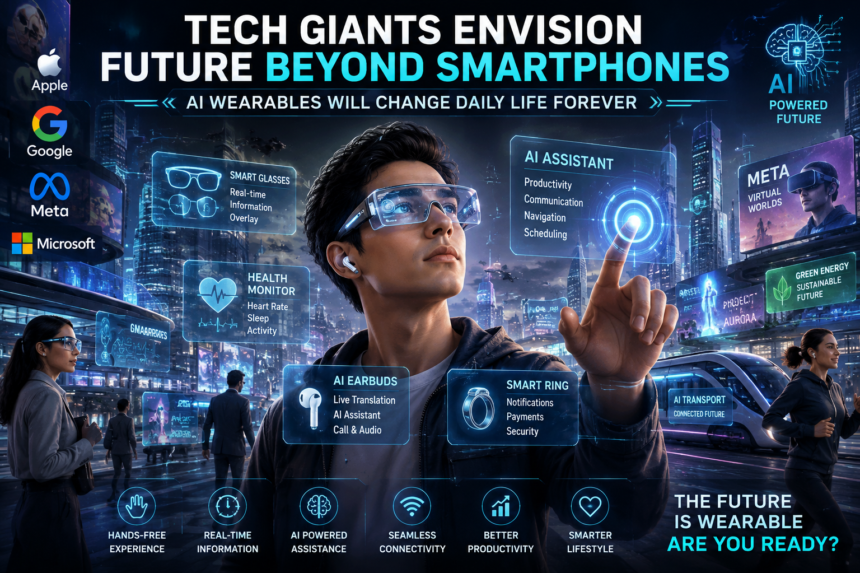
The world has already changed because of smartphones, but big tech companies believe this is just the beginning. They are now thinking beyond screens, beyond apps, and even beyond the device we carry in our hands every day.
The idea of a future without smartphones sounds strange today, but it is slowly becoming a serious direction for innovation.
Companies like Apple, Google, Meta, and others are already building technologies that could replace how we interact with phones completely.
In this article, we will explore how tech giants envision future beyond smartphones and how AI wearables might change daily life forever in ways most people have not fully realized yet.
- The Shift From Smartphones to a New Digital Era
- The Rise of AI Wearables as the Next Computing Platform
- Smart Glasses and the End of Screen Dependency
- AI Assistants Becoming Your Digital Companion
- How Daily Life Will Change Forever
- The Impact on Work, Education, and Skills
- Privacy, Ethics, and Human Concerns
- The Timeline of a Post-Smartphone Future
The Shift From Smartphones to a New Digital Era
For more than a decade, smartphones have been the center of digital life. Everything from communication to entertainment, navigation, and work happens through a small glowing screen in our hands. But tech giants now believe this model is reaching its limits. The future they are building is not about bigger or faster phones. Instead, it is about removing the need for a phone entirely.
When we talk about how tech giants envision future beyond smartphones, it means they are trying to move computing into more natural forms. Instead of tapping screens, users may interact through voice, gestures, eye movement, or even brain signals. The goal is to make technology feel invisible, always available, and more human-like.
This shift is not happening overnight. Smartphones will still exist for years, but their role may slowly shrink as new devices take over everyday tasks. Just like feature phones were replaced by smartphones, a new generation of tools is already preparing to take the spotlight.
The Rise of AI Wearables as the Next Computing Platform
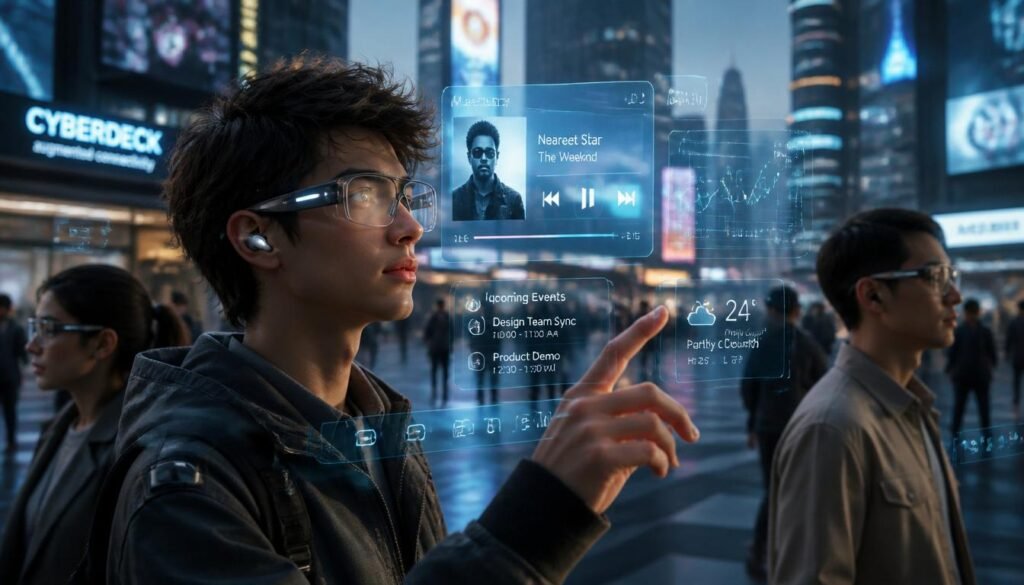
One of the strongest ideas in this future is AI wearables. These are small intelligent devices you wear instead of carry. They can come in the form of glasses, rings, earbuds, watches, or even smart clothing. The key difference is that they are powered by artificial intelligence and can understand your environment in real time.
When tech giants envision future beyond smartphones, AI wearables play a central role. Imagine wearing glasses that instantly translate languages as someone speaks. Or earbuds that act like a personal assistant, responding to questions without needing to open an app. These devices aim to reduce friction in daily tasks and make digital interaction feel instant.
Unlike smartphones, AI wearables are designed to be always on and always aware. They do not require unlocking or opening apps. Instead, they respond naturally to context. If you are walking, they might give navigation directions. If you are in a meeting, they might summarize conversations. If you are studying, they could explain concepts in real time.
This is where the real transformation begins. Technology stops being something you use and becomes something that quietly assists you in the background of your life.
Smart Glasses and the End of Screen Dependency
Smart glasses are one of the most discussed innovations in this space. Companies like Meta and Google have already shown prototypes that can display information directly in front of your eyes. Instead of looking down at a phone, you could simply look forward and see messages, maps, or notifications in your field of vision.
This is a major step in how tech giants envision future beyond smartphones. The idea is not just convenience but full immersion. Smart glasses could overlay digital information on the real world. Walking in a new city might feel like having a digital guide floating in front of you. Shopping in a store could show product reviews instantly as you look at items.
The most interesting part is how natural this interaction becomes. You would not need to stop and search for information. It would appear when needed and disappear when not. Over time, this could make smartphones feel slow and outdated compared to real-time assistance through glasses.
Of course, this also raises questions about comfort, privacy, and social acceptance. Wearing smart glasses all day is very different from carrying a phone. But tech companies are betting that as the technology improves, people will adapt just like they did with smartphones.
AI Assistants Becoming Your Digital Companion
Another major change is the evolution of AI assistants. Today, we already use voice assistants on phones, but in the future they are expected to become far more powerful and personal. Instead of asking basic questions, they could understand your habits, emotions, schedule, and environment deeply.
In the vision where tech giants envision future beyond smartphones, AI assistants are not just tools. They become companions that support decision-making throughout the day. They might remind you of important tasks before you even think about them. They could help you write emails, prepare for meetings, or even guide you in difficult conversations.
These assistants will likely exist across all AI wearables. Whether you are wearing glasses or earbuds, the same intelligence follows you everywhere. This creates a seamless digital experience where you no longer need to switch devices or apps.
Over time, this could change how people think and work. Instead of searching for information, you might simply ask your AI companion. Instead of planning everything manually, your assistant could organize your day based on your goals and behavior patterns.
How Daily Life Will Change Forever
The biggest impact of this future is not just technological but deeply personal. Daily life will feel different in almost every way. Communication, travel, learning, and even thinking processes could change.
When tech giants envision future beyond smartphones, they imagine a world where information flows naturally around you. You would not need to stop what you are doing to check your phone. Messages could appear in your ear or in your glasses. Navigation could guide you without distraction. Even entertainment could become more immersive, blending digital content with the real world.
Simple tasks like translating languages, booking appointments, or finding directions would become automatic. Instead of opening multiple apps, AI wearables would handle these tasks in the background.
This shift could make life feel smoother and more efficient. However, it also means humans will rely more heavily on AI systems for everyday decisions. That balance between convenience and dependency will become one of the most important questions of the future.
The Impact on Work, Education, and Skills
The workplace will also go through a major transformation. As tech giants envision future beyond smartphones, they are also reshaping how people work and learn. AI wearables could become essential tools in professional environments.
In offices, employees might use smart glasses to receive real-time data during meetings. AI assistants could summarize discussions instantly, making note-taking unnecessary. Remote collaboration could feel more natural, with virtual overlays helping teams interact more effectively.
Education will also become more interactive. Students could learn through real-world experiences enhanced by digital information. Imagine studying biology while seeing animated diagrams appear over real objects, or learning history while walking through reconstructed digital environments.
However, this also means skills will change. Traditional memorization may become less important, while critical thinking, creativity, and adaptability will matter more. People will need to learn how to work with AI instead of competing with it.
The job market will evolve too. New careers will emerge in AI system management, wearable interface design, and digital experience optimization. At the same time, some traditional roles may disappear or become automated.
Privacy, Ethics, and Human Concerns
While the future sounds exciting, it also brings serious concerns. When devices are always listening and always watching, privacy becomes a major issue. AI wearables will collect large amounts of personal data, including location, behavior, and conversations.
When tech giants envision future beyond smartphones, they must also address how this data is protected. Without strong privacy systems, users could feel constantly monitored. This could create discomfort and resistance to adopting new technologies.
There are also ethical questions about dependence. If AI systems make too many decisions for humans, it could reduce independent thinking. People might rely too much on digital guidance instead of personal judgment.
Another concern is digital inequality. Advanced AI wearables may initially be expensive, meaning only certain groups can access them. This could create a gap between those who have enhanced digital abilities and those who do not.
These challenges will need careful regulation and responsible design. The success of this future depends not only on innovation but also on trust.
The Timeline of a Post-Smartphone Future
The transition away from smartphones will not happen suddenly. It will likely be gradual, unfolding over the next decade or more. At first, AI wearables will act as companions to smartphones rather than replacements. People will use both together.
As technology improves, wearables will become more independent. Battery life, processing power, and connectivity will continue to advance. At some point, smartphones may become secondary devices used only in specific situations.
When tech giants envision future beyond smartphones, they often describe a layered transition. Early stages will focus on convenience features. Later stages will move toward full replacement of phone-based interaction. Eventually, screens may become less central to daily life.
However, adoption will depend on user comfort. People will only move away from smartphones when new devices are clearly better, easier, and more natural to use.
Conclusion
The idea that technology could move beyond smartphones is no longer science fiction. It is a real direction being actively developed by the world’s biggest tech companies. Through AI wearables, smart glasses, and intelligent assistants, the way humans interact with digital systems is about to change dramatically.
As tech giants envision future beyond smartphones, they are not just building new devices. They are redesigning how humans experience information, communication, and daily life itself. This future promises greater convenience, deeper integration, and more natural interaction with technology.
But it also brings important questions about privacy, dependence, and control. The next decade will decide whether this transformation becomes the most positive shift in human history or a complex challenge we must carefully manage.
One thing is clear: the smartphone era changed the world, but the next era may change what it means to be connected at all.
FAQs
What does it mean when tech giants envision future beyond smartphones?
It means companies like Apple, Google, and Meta are developing new technologies such as AI wearables and smart glasses that could eventually replace traditional smartphones and change how people interact with digital information.
Will smartphones completely disappear in the future?
Smartphones will not disappear immediately. They will likely remain useful for many years, but their importance may slowly decrease as new wearable technologies become more advanced and practical for daily use.
What are AI wearables?
AI wearables are smart devices like glasses, earbuds, rings, or watches that use artificial intelligence to assist users in real time. They can understand context, respond to voice commands, and provide information without needing a phone.
How will AI wearables change daily life?
They will make everyday tasks faster and easier by providing instant information, real-time translation, navigation assistance, and personal support without requiring users to open apps or use screens.
What are the biggest concerns about this future technology?
The main concerns include privacy risks, data security, over-dependence on AI, and unequal access to advanced devices. These issues need careful attention as the technology develops further.